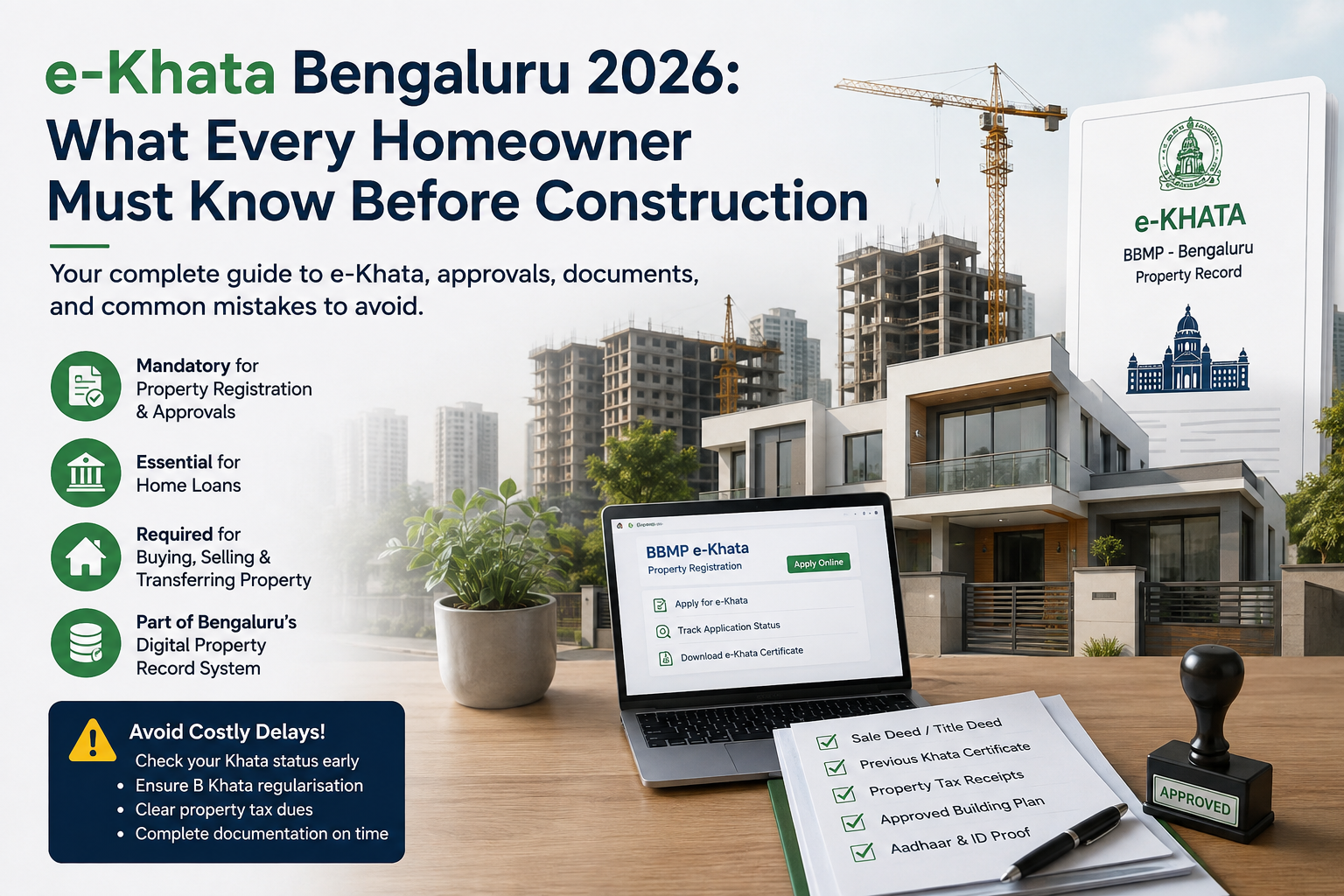
If you're planning to build, buy, or register a property in
Bengaluru, there's one document you cannot ignore in 2026 — the e-Khata.
With BBMP making e-Khata mandatory for property transactions and approvals,
understanding this process early can save you months of delay and legal hassle.
Here's everything homeowners need to know before starting construction.
What Is an e-Khata?
An e-Khata is the digital version of the traditional Khata
certificate — an official record that establishes property ownership and is
used to assess property tax. It's issued by the BBMP (Bruhat Bengaluru
Mahanagara Palike) and is now a mandatory requirement for:
- Registering
a new property - Applying
for a building or construction plan approval - Availing
a home loan - Selling
or transferring property ownership
Why e-Khata Matters More Than Ever in 2026
Bengaluru has moved decisively toward digitizing property
records, and e-Khata registration is now tightly linked to legal
property recognition. Without a valid e-Khata:
- Your
building plan approval can be delayed or rejected - Banks
may refuse to sanction a home construction loan - You
may face complications during resale or property transfer
This shift is part of a broader property regularisation
drive — including A Khata to B Khata conversions — aimed at bringing all
Bengaluru properties into a transparent digital record system.
Documents Typically Required
- Sale
deed or title deed - Previous
Khata certificate (if available) - Property
tax paid receipts - Approved
building plan (or application, if construction is upcoming) - Aadhaar
and identity proof of the owner
Common Mistakes Homeowners Make
- Starting
construction before confirming Khata status — leading to approval
delays later - Assuming
B Khata properties can be built on freely — B Khata properties often
carry restrictions until regularised - Ignoring
property tax mismatches, which can stall the e-Khata application - Delaying
documentation until after construction begins, which risks approval
and loan complications midway